|
◆ The Take ◆
|
|
The companies winning at AI are changing what they expect from people when using tools.
Ramp's CPO published their adoption playbook this week. 99.5% of employees use AI. Non-engineers are submitting 12% of production code changes. They shipped 1,500 internal apps in six weeks. Impressive numbers.
The first instinct is to ask "which tools did they use?" Skip that question. The tools are Claude, ChatGPT, the usual suspects. What matters is that Ramp made AI proficiency a performance expectation, removed every approval bottleneck on tokens and connectors, and built a public leaderboard so builders got recognized.
The second question, maybe more relevant: are those 1,500 apps actually useful, or is Ramp shipping for the sake of shipping? A leaderboard that rewards volume... gets you volume. The same headaches that made internal software painful before AI (maintenance, documentation, knowledge transfer when someone leaves) don't disappear because the tool was written in an afternoon (though, still cool!).
Eventually, the culture needs to reward building, but it also needs to draw a line between "solves a real problem" and "impressive demo that nobody uses two weeks later."
So the Ramp numbers are real but, if you ask me, the framing around them has a bit of press release energy (remember the Klarna AI doing most of support that was later backtracked?). The companies that will pull ahead won't just remove friction for builders. They will also decide what "good" looks like once the app is shipped and define how that app is kept relevant. And that's a whole other playbook.
Read their playbook here
|
|
|
◆ The Signal ◆
|
Claude Opus 4.7 Is Out Today and the Non-Developer Story Is Worth Knowing
What happened. Anthropic released Claude Opus 4.7 today across all Claude products, including the paid tiers at claude.ai. No API required to use it. The headline improvements are in complex, multi-step tasks: the model now checks its own reasoning before reporting back, catches logical errors during planning (not just after), and handles longer autonomous runs without going off the rails. Vision got a meaningful upgrade too: it reads charts, diagrams, and dense documents at higher resolution, which matters for anyone feeding it reports, financials, or slides.
The reality. Most of the launch testimonials are from software companies testing it on code. I've been running it for a few hours and still undecided if I feel a difference. On the non-developer angle: two things worth noting. First, the improved vision should be helpful (my initial tests are rather positive!), second a model that says "I'm not sure, let me verify" instead of confidently filling gaps with plausible nonsense is worth having - let's see if that's the case here in practice. Same price as the previous version on Claude.ai paid plans.
→ Your move. If you use Claude for document analysis or multi-step research tasks, switch to Opus 4.7 in your next session and notice whether it flags uncertainty differently than you're used to. |
|
Ramp Published Its Internal AI Playbook. The Numbers Are Absurd.
What happened. Ramp's CPO shared the fintech company's full AI adoption strategy publicly. The company-reported results: 6,300% increase in internal AI usage over the past year. 99.5% of employees actively using AI tools. Non-engineers now write 12% of production code. These are self-reported figures from Ramp's own leadership, not independently audited.
The reality. Ramp is an engineering-heavy fintech company. Replicating 99.5% adoption in a services firm will be harder. But the playbook's 8 levers are organizational, not technical: proficiency ladders, visible leaderboards, removing approval bottlenecks, baking AI into hiring. Even with my disclaimers on if this output level with AI-generated tools is sustainable, this is worth watching and thinking through (tools don't matter as much as we might think).
→ Your move. Set up a shared Slack channel this week where your team posts AI wins. This compounds over time. |
|
Canva Launches AI 2.0 With Agentic Design Features
What happened. Canva unveiled its AI 2.0 overhaul as a research preview. The design tool is positioning itself to let users direct multi-asset campaigns using natural language while agentic AI (AI that takes actions on its own, not just answering questions) handles execution. You describe a campaign and Canva builds the assets across formats.
The reality. This launched as a research preview, so not all Canva users will see the new interface immediately. Canva's advantage is its 220M+ monthly users. The AI features land inside a tool they already know. Whether output quality matches a skilled designer on real brand work is to be seen but design is certainly poised to see the same acceleration coding did.
→ Your move. Check whether your Canva account has access to the new AI 2.0 interface. If so, rebuild one existing social campaign and compare time-to-first-draft against your current process. |
|
Snap Cut 1,000 Jobs and says AI Writes 65% of Their Code
What happened. Snap laid off 16% of its workforce, roughly 1,000 people. CEO Evan Spiegel explicitly cited AI-driven efficiency as part of a broader restructuring push targeting $500 million+ in annualized savings. AI now writes over 65% of Snap's new code (per Snap's own investor presentation), letting smaller teams maintain the same output. Activist investor Irenic Capital had pushed for a 21% workforce cut, citing AI replacement and Snap delivered 16%.
The reality. On one end, I'm not entirely sure this is as much about AI as it sounds. It's a lot nicer to say you reduced workforce because of AI than to say you did so because you're still trying to get to "solid profitable" territory or you overhired in the covid years. On the other, Snap is a tech company with highly automatable coding workflows. The 65% figure won't translate to client services or knowledge work. But the precedent matters: a public CEO cited AI as a factor in reducing headcount, on the record. One of the clearest public examples of a company framing layoffs as partly AI-driven.
→ Your move. Audit one recurring task your team does manually and estimate how many hours it takes per month. That's the number a future CFO will run AI against. |
|
|
|
◆ Also on the Radar ◆
|
| ◆ | The U.S. ranks just 24th globally in generative AI adoption at 28.3%; Singapore leads at 61% (a government push to subsidize AI tools and push for AI literacy is likely behind it). (Stanford HAI) |
| | ◆ | Google launched a native Gemini Mac app yesterday. Free, works on macOS 15+, pops up anywhere with Option + Space. Gemini is the last of the three major AI assistants to have a dedicated Mac app; ChatGPT and Claude have been there for a while. (Google Blog) |
| | ◆ | McKinsey, BCG, and Bain are reconsidering whether entry-level analyst roles still make sense as AI handles research and slide-building. (Bloomberg) |
| | ◆ | Claude is now available as a native sidebar in Microsoft Word (public beta, Team and Enterprise plans only), finishing the Office suite after Excel and PowerPoint. (Anthropic) |
| | ◆ | Visa launched payment infrastructure for AI agents (software that acts on your behalf) to browse, select, and pay for goods autonomously. (Visa Newsroom) |
| | ◆ | Job postings requiring "agentic AI" skills exploded while "ChatGPT" skill demand declined year-over-year, according to Lightcast/Stanford data. Interesting and points where businesses see AI heading. (Lightcast / Stanford). |
|
|
|
◆ Reality Check ◆
|
|
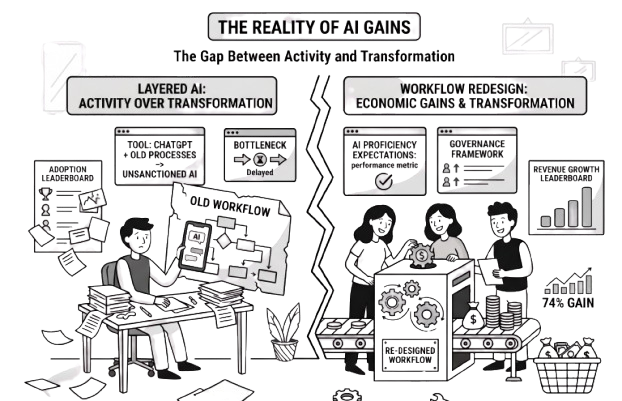
“Companies investing seriously in AI are seeing real returns.” PwC's 2026 AI Performance Study, out April 13, found that 74% of AI's financial gains go to just 20% of organizations. But the same study found that 56% of companies report no significant financial benefit from AI at all.
The headline is getting circulated as "AI works if you do it right." But my read on the actual finding is bleaker: most companies are spending on AI without seeing returns, not because the technology doesn't work, but because the majority of AI activity is "vibe experiments": ad-hoc use, without a coherent strategy, without the organizational changes to support sustained adoption and without the incentive structure to make people care.
PwC found that the technology itself delivers roughly 20% of an AI initiative's value. The remaining 80% comes from redesigning work. Most organizations invest heavily in the 20% (tools, models, access) and underinvest in the 80% (workflow redesign, governance, reskilling, outcome measurement).
The Goldman Sachs read is similar: "We still do not find a meaningful relationship between productivity and AI adoption at the economy-wide level" — though they do find a 30% productivity gain in two specific localized use cases (coding and customer service).
What we still don't knowWhether the 20% of winners are structurally different companies (larger, better-resourced, more technically mature) or whether their practices are genuinely replicable. PwC says it's the practices. I don't necessarily know that to be true. Change takes time, a lot more than technologists (me!) estimate and certainly less than what consultancies sell.
Source: PwC
|
|
|
◆ Tool of the Day ◆
|
NotebookLM
|
|
Upload any documents (reports, transcripts, contracts, decks) and interrogate them in plain language. Every answer cites exactly where it came from.
| Use this when You're drowning in research before a client meeting or proposal and need to pull consistent, sourced answers from five PDFs without reading all five. Also works for onboarding: upload your SOPs and let new team members ask questions. | Why this one Most people start to know of NotebookLM but it's still rather valuable and worth recommending. Why? Most AI chat tools answer from memory and hallucinate. NotebookLM answers only from what you uploaded, with citations you can check. It also does something genuinely unusual: it can turn your source documents into a two-host podcast discussion of the material. Useful for absorbing a dense report on a commute. | Watch out for The paid tier ($19.99/month) is bundled into Google One AI Premium. The free tier is usable but caps daily queries. | Price Free tier available. NotebookLM Plus at $19.99/month via Google One AI Premium. | Source |
|
|
|
◆ Workflow Unlock ◆
|
For: Anyone who needs to distill a long document into something a busy stakeholder will actually read: manager, client, board member, partner, whoever holds the decision. To: Turn a dense report, brief, or research dump into a one-page summary that leads with what matters to *that specific person. | 1 | Paste the full report into Claude or ChatGPT. Add this prompt:
Prompt Extract every factual claim and its supporting evidence from this document. List them as claim-evidence pairs. Flag any claims without clear evidence. |
| | 2 | Follow up with:
Prompt I'm presenting this to [describe your stakeholder, e.g., 'a VP who cares about timeline risk and budget' or 'a client who needs to decide whether to proceed']. Reorder these claims by relevance to their priorities. Drop anything they wouldn't act on. Rewrite the top 5-7 in plain language, one sentence each. Put the single most important action at the top. |
| | 3 | Spot-check the top 3 claims against the original document. Add your own judgment. Send.
|
Watch out for: The AI will confidently attribute claims to the document even when paraphrasing loosely. Always verify before sending to a client.
|
|
◆ The Wow ◆
|
|
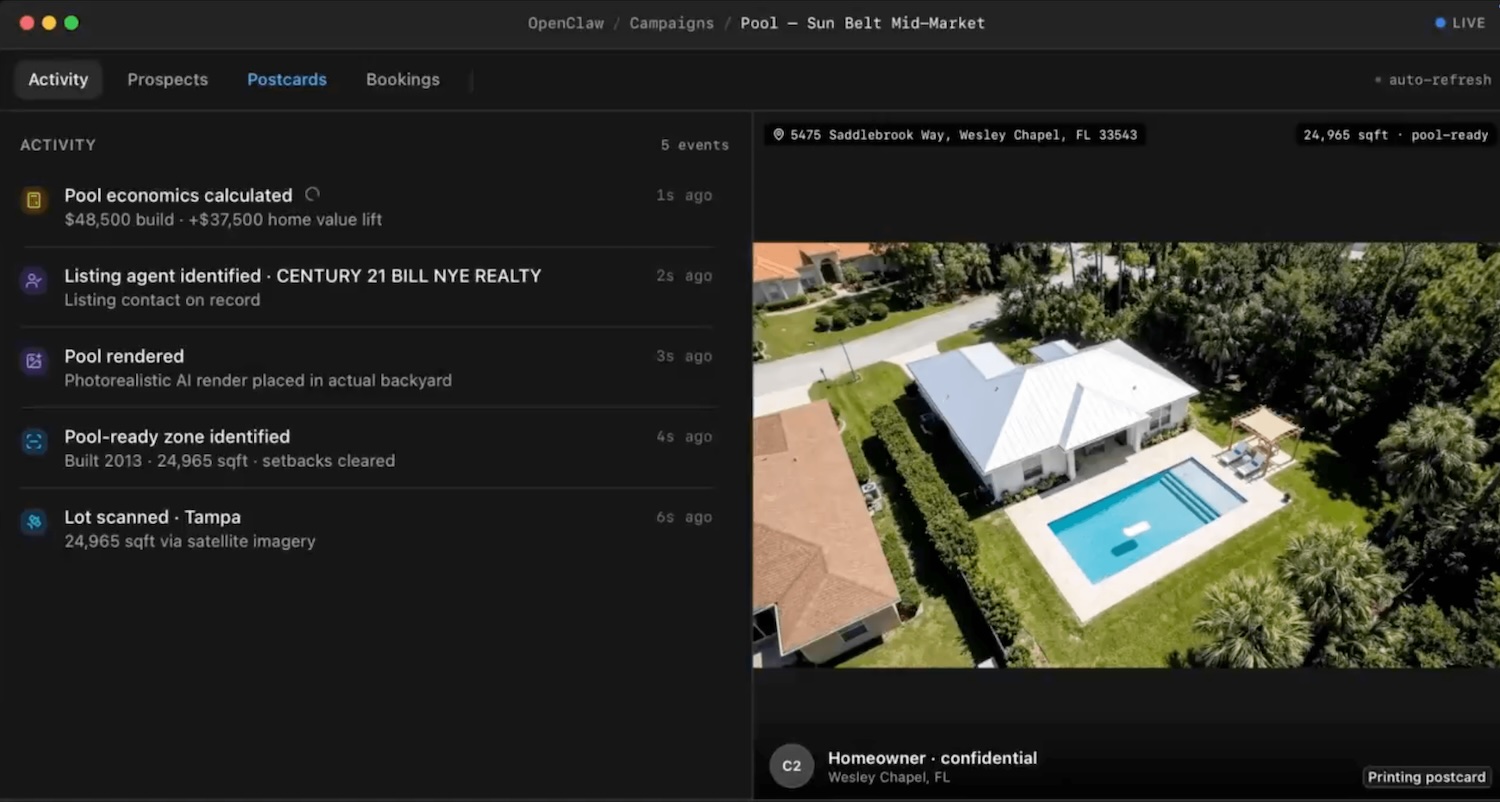
This bot scans satellite imagery, renders a pool in your backyard, and mails you a personalized postcard. Fully automated.
OpenClaw finds mid-market homes without pools via satellite, pulls owner info from public records, renders a luxury pool into their actual backyard using AI, calculates build cost plus home value increase, generates a cinematic before/after video, prints a personalized postcard, and mails it. A disclaimer. This is technically possible today, though I'm not sure the author is really presenting something real (couldn't confirm). That said the premise is solid and the underlying pattern (identify prospect, personalize the pitch, automate delivery) works for any outbound business and showcases the power of personalization that AI unlocks and would otherwise be impossible without. Source: Chris (@everestchris6) via X
|
|
◆ Further Reading ◆
|
| "The 2026 Stanford AI Index — Full Report" (Stanford HAI) — Looks like the most authoritative annual data source on where AI actually stands, not produced by a lab with skin in the game. | | "Half of U.S. Workers Now Use AI, But Organizations Haven't Changed How Work Gets Done" (Gallup) — Hard data on AI productivity gains by role level; leaders report stronger impact than individual contributors. | | "AI Strategy for Non-Technical Founders: How to Lead Without Writing Code" (Medium) — Operational playbook with a 60-day rollout timeline. Key frame: "you win AI by owning a workflow, not by arguing about models." | | "The Only Moats That Matter" (Michael Bloch, Quiet Capital) — Five categories of business defensibility AI can't compress: proprietary data, network effects, regulation, capital, physical infrastructure. | | "AI-Native Law Firms Are Getting Regulated and Funded" (Lupl) — Law firms built from scratch around AI, offering regulated advice at flat fees starting at £95 per contract. |
|
|